Heat Mapping Software
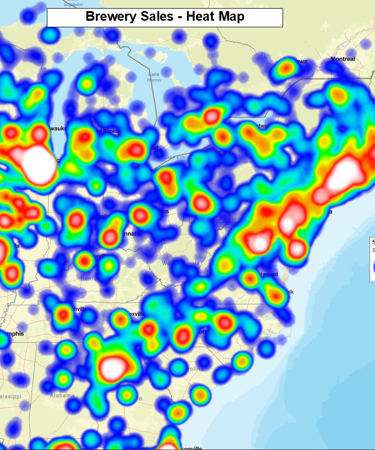
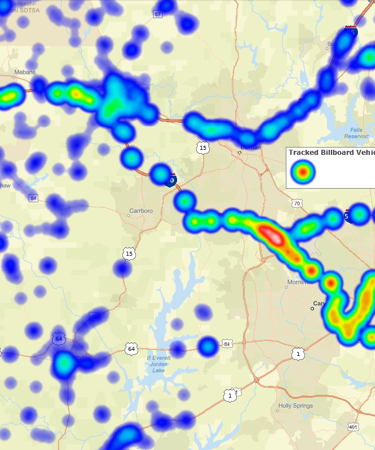
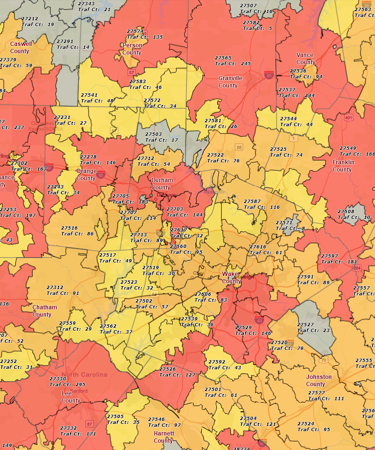
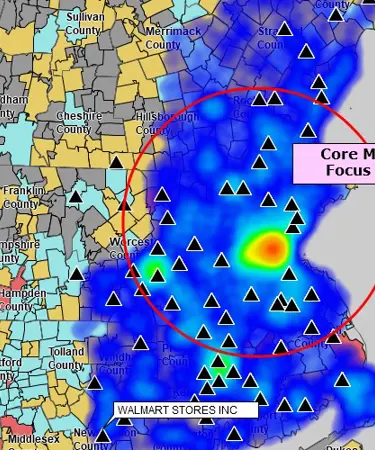
Put Heat Mapping to Work
- Generate heat maps based on location density and (optionally) a selected numeric value to make the relative concentration and intensity of your business data immediately visible.
- Import Excel or CSV files with customer, sales, or other location-based business data.
- Identify hotspots, underserved areas, and market opportunities to support sales and marketing analysis, territory planning, site planning, and other location-based business decisions.
- Add demographic and business context to your heat maps by color coding your base map by demographic data and plotting relevant Business Listings (both available with your subscription).
- Create color-coded boundary maps by ZIP Code, county, state, or other area when you need to visualize business or demographic values by area rather than location concentration.
- Share and present your business maps to communicate insights with colleagues and decision-makers.
Generate a Heat Map from Your Location Data
To create a heat map from your own Excel or CSV file, the file should include columns with location information and, if you want to visualize a business value rather than location density alone, a numeric column containing the value you want to use as a heat parameter. Location information can be provided in separate address fields such as Address, City, State, and ZIP Code.
For example:
| Address | City | State | ZIP Code | Sales Q1 |
| 101 School St | Morganton | IL | 47301 | $24,989 |
| 56 Bourbon St | Borlynn | OH | 34789 | $55,300 |
After you import the list, MapBusinessOnline plots your locations and lets you create a heat map from the mapped data:
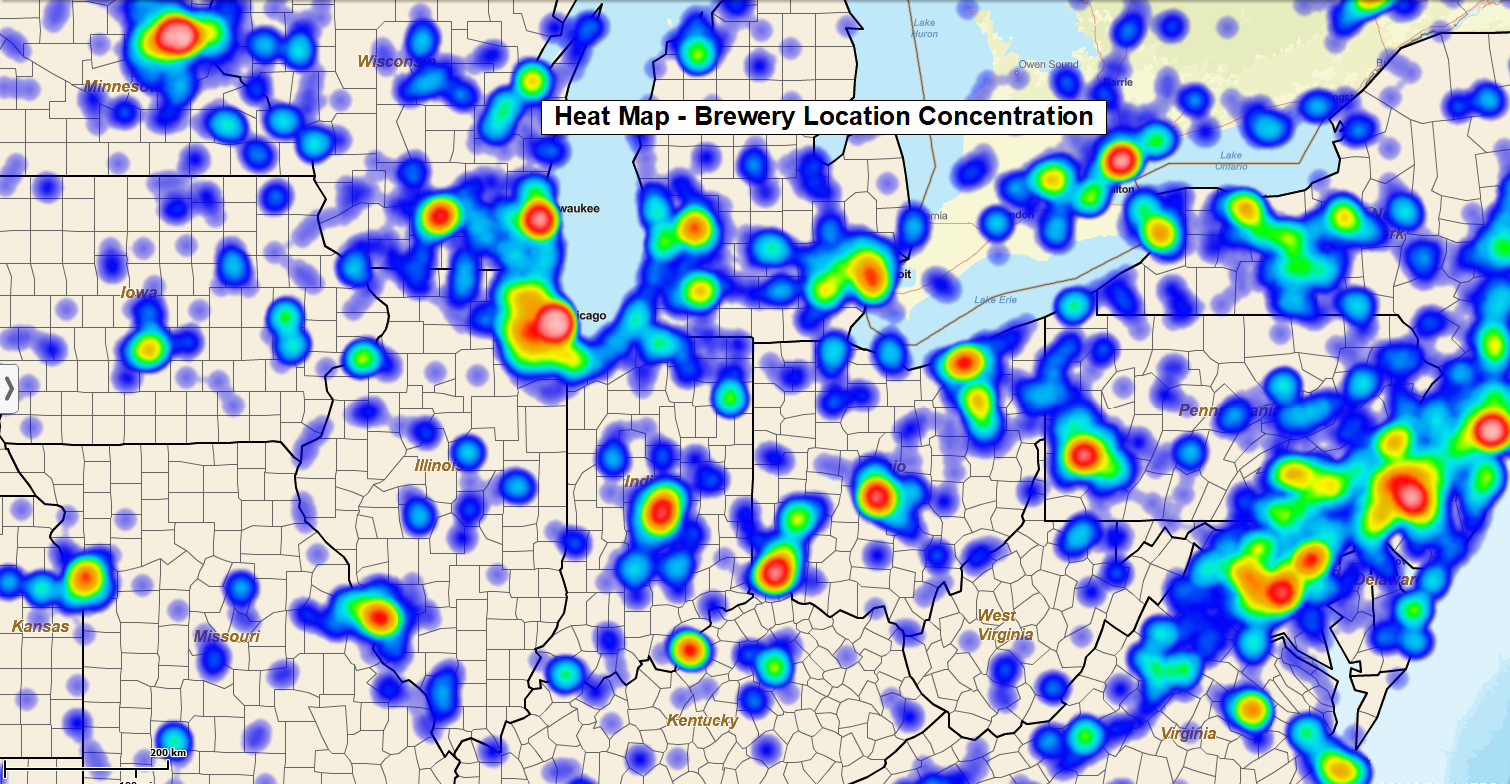
- A density-based heat map shows where your mapped locations cluster. Areas containing more nearby locations appear with greater heat-map color intensity:
- When you select a numeric column such as sales to be used as the heat parameter, the heat map reflects where higher values are geographically concentrated. Locations with higher values contribute more strongly to the resulting hotspots:
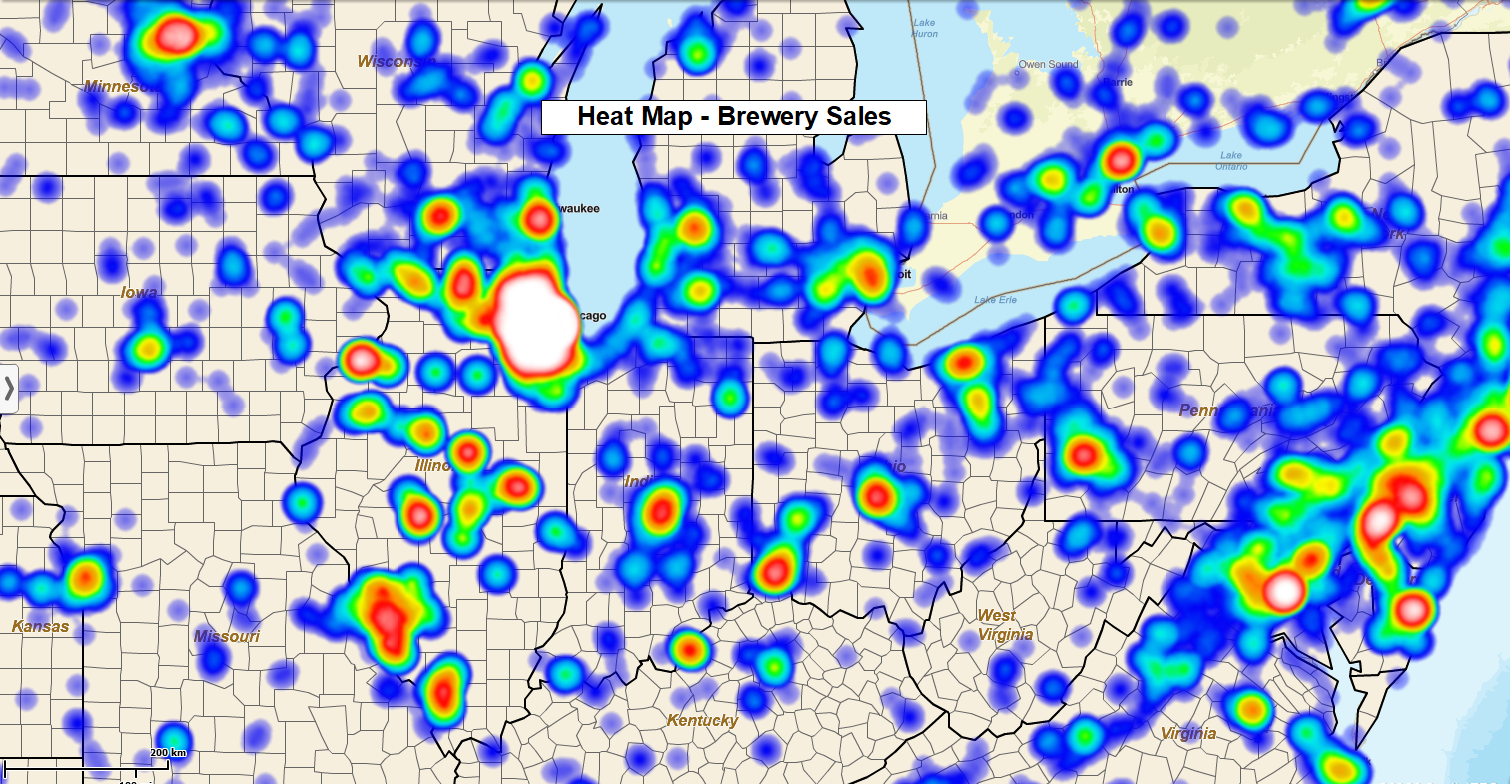
The result is a geographic heat map directly connected to the locations and business values in your spreadsheet. You can adjust the color palette and heat radius to make the patterns easier to interpret.
Learn from a Business Heat Map
Visualize sales activity – see where sales are occurring and identify areas where business activity is stronger or weaker. Compare heat map views over time to see where sales activity is growing or declining and use those changes to inform sales and marketing priorities.
Find concentrations of customers or prospects – reveal areas of higher activity in your mapped location data to support sales and marketing planning. Compare customer density with sales results to distinguish markets with a strong customer base from areas where customer concentration is not translating into equivalent sales activity.
Identify underserved markets – compare areas of high and low activity to help recognize potential gaps and opportunities. Add Census demographics to evaluate whether a low-activity area also contains the population or household characteristics relevant to the market you're targeting.
Support retail location planning – overlay candidate locations on a ZIP Code map color-coded by population or median household income and generate a heat map of competitor locations in the area. This lets you evaluate a potential site in the context of both customer or business activity shown by the heat map and the demographic characteristics of the surrounding market.
Visualize risk or incident concentrations – map numeric location-based data, such as crime incidents, epidemic outbreaks, or insurance claims, to identify areas where activity or risk is concentrated. For insurance analysis, claims can also be summarized by ZIP Code and the ZIP Codes color-coded by risk assessment; for healthcare, successive heat maps can help track how the geographic pattern of an outbreak changes over time.
Review competitor density – search and map relevant Business Listings and compare competitor concentrations with your own business data. Filter Business Listings by criteria such as industry, sales, or employee count, then use competitor density together with customer and demographic data to investigate market saturation or potential expansion areas.
Heat Map or Color-Coded Boundary Map?
Heat maps and color-coded boundary maps both use color to reveal geographic patterns. Color-coded ZIP Code, county, or state maps are sometimes also referred to as heat maps. In MapBusinessOnline, they are separate visualization features designed for different questions.
Create a heat map when you want to visualize the density of mapped locations or the geographic intensity of a numeric value associated with those locations. The resulting color pattern is based on your location data rather than predefined geographic boundaries.
Create a color-coded boundary map when you want to compare values across defined geographic areas such as ZIP Codes, counties, states, Census tracts, or territories. Color shade these areas using imported business data or included demographic data:
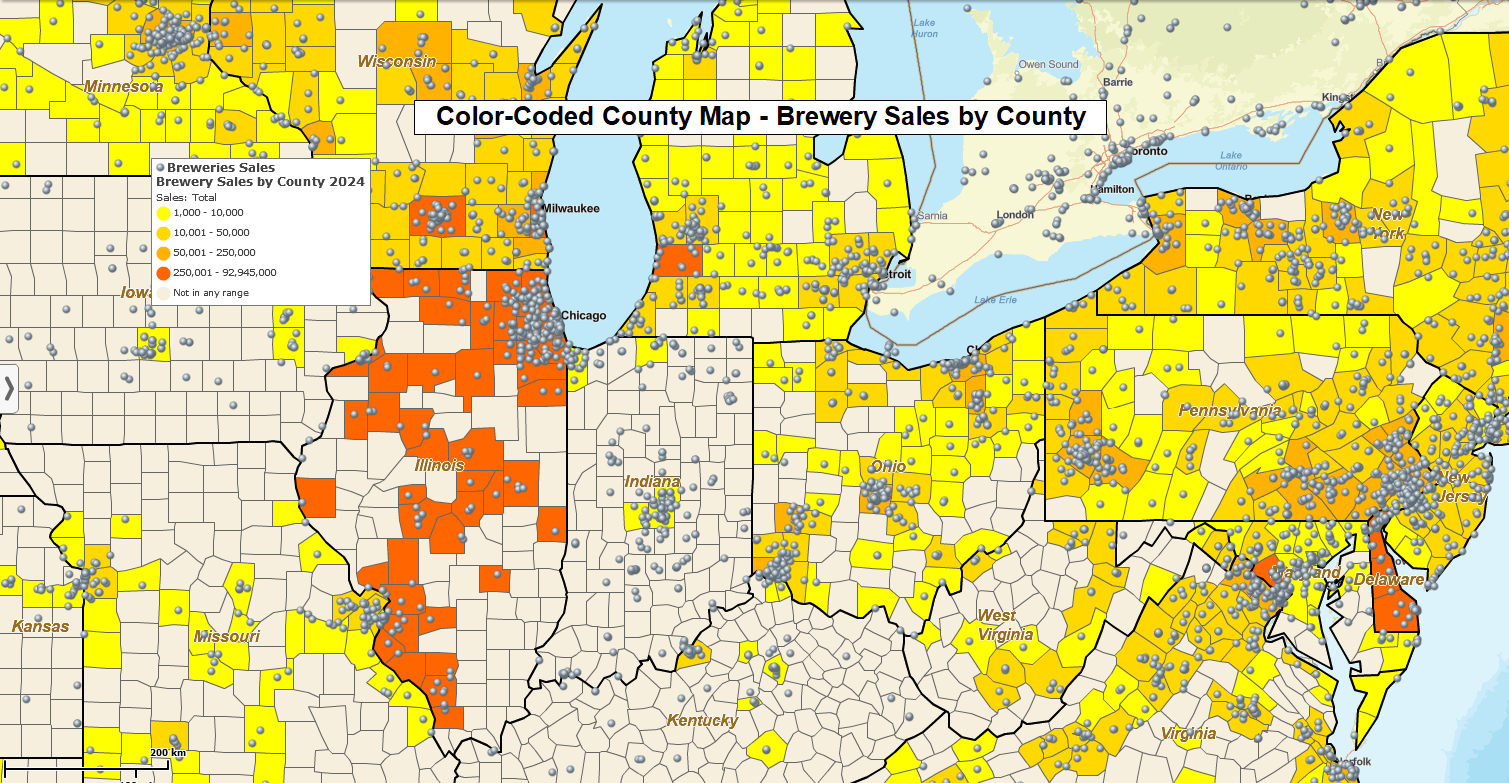
For example, you might use a point-based heat map to reveal where customer or sales activity is concentrated, while using a color-coded boundary map to compare population or household income across ZIP Codes when evaluating markets.
See MapBusinessOnline in Action
Request a demo
Learn How Our Customers are Succeeding with MapBusinessOnline

"MapBusinessOnline one of the most powerful tools I have as a Regional Channel Manager. It’s a difficult task to visually represent the vast amount of data that I have to present to my customers and team members. MBO makes it easy to represent, configure, and manipulate the data on to an effective map. A picture is worth a thousand words, and MBO allows me to create a perfect picture."
Ed Ku
Regional Channel Manager
ABB

"In a large company, with many layers of sales teams, sales management, territories, operations teams and distribution, it is vital to have a solution to quickly and easily display country and regional maps. I have tried multiple other mapping solutions in the past only to be frustrated by their limitations or by their complexity. MapBusinessOnline perfectly fits my need. MBO has the versatility to allow me to build somewhat complicated maps but also allows me to knock out the quick, one-off request. MBO continues to add features and I am excited to see what new features come out next."
Dave Perek
Sr Business Analyst
Schneider Electric


"This software has been tremendously helpful in mapping out my company’s sales territories map. I have researched many other products, but no one came close to the ease of use of data customization options MapBusinessOnline provides. Also, their maps are extremely accurate and pleasing to the eye. Sales projections and territory expansions can be easily mapped out with this software. Most importantly, they provide free training and a vast number of video guides that have been extremely helpful. It is apparent that this company cares about their product and their customers. Really happy with it."
KC Cooley
Credit Manager
Crediauto Financial

Popular MapBusinessOnline features
Emphasize customers density with heat maps

Highlight market areas that generate more business. Visually compare map areas for business potential. Select from a variety of heat map colors and options.
Color code maps by ZIP code, county, or state

Import business data by ZIP code to show it geographically. Create colorful maps for business analysis that connect real Census data to locations on the ground.
Display business data against demographic maps

Categorize geographic areas by population or household income. Explore new markets, business patterns, or social trends against color coded Census maps for business and competitor analysis.
Build fast map visualizations of your business data

Map business data from various sources by street address, city name, ZIP code, or latitude and longitude. Plot 250,000 or more locations on a map at once. All you need to start is a spreadsheet with business data.
Illustrate business data on map with charts

Graphically depict your business data on a map using pie or bar charts. Use charts to show sales by product, invoices due vs. paid, products ordered vs. shipped, and sales by customer demographics.
Visualize business data on map with various symbols

Assign specific symbols, colors, and sizes to your data points on map. Choose from a wide variety of symbols or create your own. Visually define customers and prospects across multiple locations using symbols color coding.
Add a variety of layers and data to map

Includes ZIP codes, Counties, States, Metropolitan Statistical Areas (MSA), Census Tracts, City Limits, ZIP3 codes, US cities, Highways, and other map layers.
Print large format map views

Print large maps to use in presentations and project plans. Save maps as PDF files to print as large as 60” x 60” customer maps. Supports multiple pages option to use your home or office printer for large wall maps.
Share business maps

Create interactive maps and share with friends, colleagues, dealers, customers, prospects or vendors. Share territory maps. Email saved JPEG and PNG files or embed map files in PowerPoint presentations. Includes PDF export for larger print formats.


